Hola como estas !!!
El descanso del Finasteride no es obligatorio pero lo ideal es tomarlo por dos años y darle un descanso de 5/6 meses y asi sucesivamente, de esa manera siempre esta actuando correctamente.
Según este estudio, tampoco esta nada mal dejarlo de tanto en tanto...
Manuel escribió:Pero voy a ser bien concreto y con un estudio (CrossOver) en mano para responderte y "demostrarte" que es mejor dejar el Finas que no dejarlo.
En este estudio (a cinco años) se muestran cuatro casos diferentes:
1) Un grupo que tomó Propecia 5 años sin parar.
2) Un grupo que tomó Propecia desde el segundo año.
3) Un grupo que tomó el primer año, descansó el segundo y retomó al tercero siguiendo sin parar hasta el quinto.
4) Un grupo que no tomó nunca nada (placebo).
La siguiente imagen muestra un gráfico del estudio:
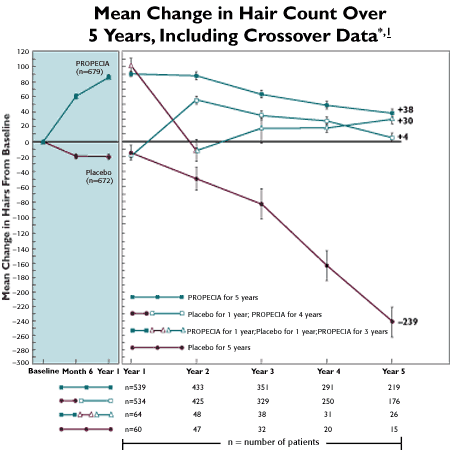
Fijate vos que el único grupo que sigue en ascenso (a pesar de no haber alcanzado todavía al grupo 1, es el que descansó un año completo.
Conclusion: no se sabe cuanto hay que descansar ni por cuanto tiempo. Lo que es -en principio- seguro es que en algunos casos, comienza a perder efectividad y que aquellos que tomaron un año y descansaron otro, al quinto año siguen subiendo en la curva.
El champo con ketoconazol 2% actua de forma similar al Minoxidil 2% ya que es un antiandrogeno suave ademas de antiseborreico y antifungico. Este champo se puede usar solo dos veces por semana y es a largo plazo que se ven los resultados. Igualmente es recomendable usarlo como complemento.
Aca te dejo unos estudios ( Ingles ) para que saques tus propias conclusiones :
It can reasonably be concluded that the clinical efficacy of ketoconazole shampoo in the treatment of AGA is primarily a function of DHT pathway disruption rather than an anti-inflammatory effect. In rat studies ketoconazole caused 5-R inhibition [28]. Furthermore, in humans ketoconazole has also been shown to inhibit the binding of 5-R to sex hormone globulins [29]. These clinical studies suggest that ketoconazole like finasteride may inhibit the production of DHT. Unlike finasteride ketoconazole has been shown to bind to human AR [30]. Thus, the effect of ketoconazole on the DHT pathway may be two-fold: inhibition of DHT and/or inhibition of DHT binding to AR. Either or both of these properties would result in reduced incidence of DHT binding to AR and inhibiting the pathway that leads to the miniaturizing of hair follicles.
March 04, 2001 - American Academy of Dermatology Meeting - Washington DC - Scientists working for McNeil, makers of Nizoral anti-dandruff shampoo, presented the findings of a study done on 1% Nizoral shampoo which has good news for hair loss sufferers. It has long been known that 2% prescription Nizoral has beneficial effects on Androgenic Alopecia (MPB). It however has been unclear whether the same benefits can be obtained by using the non-prescription 1% version.
In the study presented (see below), one hundred male volunteers with mild to moderate dandruff and somewhat oily scalp, were using, in a double-blind fashion, either a 1% Nizoral shampoo or a 1% zinc pyrithione shampoo, 2-3 times a week for 6 months.
Analysis of the different parameters set up in the study shows that the hair diameter gradually increased with Nizoral use (+8.46%) over a 6 month period, whereas the diameter showed a trend to decrease with zinc pyrithione use over the same period (-2.28%). The sebum excretion rate was reduced with Nizoral (-6.54%) while it increased with zinc pyrithione (+8.2%) over the same period of time. The number of hair shed over a 24-hour period was reduced by 16.46% with Nizoral and 6.02% with zinc pyrithione after 6 months. Finally, the percentage hairs in anagen phase increased by 6.4% and 8.4% respectively during the study time.
The results are similar to a previous study done on 2% prescription strength Nizoral where it was shown that use of 2% Nizoral yielded a 7% average increase in hair shaft diameter similar to what was achieved by the control group using 2% Minoxidil and a non-medicated shampoo.
So for any hair loss sufferer, this research clearly indicates that using 1% or 2% Nizoral 2-3 times per week, will have positive effects on hair growth as well as controlling dandruff. It is still unclear at this time whether it's the anti-fungal properties or the anti-androgenic properties of Ketokonazole (active ingredient in Nizoral) thats responsible for the hair thickening effects, however because of the decrease in sebum rates as well, it is the authors opinion that the results are due to the anti-androgenic properties of Ketokonazole.
California College of Podiatric Medicine, 371 Columbus Avenue, San Francisco, CA 94133, USA.
Dihydrotestosterone (DHT) binding to androgen receptors (AR) in hair follicles is commonly accepted as the first step leading to the miniaturizing of follicles associated with androgenetic alopecia (AGA). Testosterone is converted to DHT by the enzyme 5alpha-reductase. Finasateride a 5alpha-reducase inhibitor blocks the production of DHT and is currently used to treat AGA. The inhibition is not complete but a reduction of DHT systemically and in the scalp is accomplished. Ketoconazole has been clinically shown to be effective in the treatment of AGA. In this paper, evidence is presented to support the hypothesis that ketoconazole 2% shampoo has a local disruption of the DHT pathway. It is proposed that using ketoconazole 2% shampoo as an adjunct to finasteride treatment could lead to a more complete inhibition of DHT and thus better treat AGA.
PMID: 14729013 [PubMed - indexed for MEDLINE]
March 04, 2001 - American Academy of Dermatology Meeting - Washington DC - Scientists working for McNeil, makers of Nizoral anti-dandruff shampoo, presented the findings of a study done on 1% Nizoral shampoo which has good news for hair loss sufferers. It has long been known that 2% prescription Nizoral has beneficial effects on Androgenic Alopecia (MPB). It however has been unclear whether the same benefits can be obtained by using the non-prescription 1% version.
In the study presented (see below), one hundred male volunteers with mild to moderate dandruff and somewhat oily scalp, were using, in a double-blind fashion, either a 1% Nizoral shampoo or a 1% zinc pyrithione shampoo, 2-3 times a week for 6 months.
Analysis of the different parameters set up in the study shows that the hair diameter gradually increased with Nizoral use (+8.46%) over a 6 month period, whereas the diameter showed a trend to decrease with zinc pyrithione use over the same period (-2.28%). The sebum excretion rate was reduced with Nizoral (-6.54%) while it increased with zinc pyrithione (+8.2%) over the same period of time. The number of hair shed over a 24-hour period was reduced by 16.46% with Nizoral and 6.02% with zinc pyrithione after 6 months. Finally, the percentage hairs in anagen phase increased by 6.4% and 8.4% respectively during the study time.
The results are similar to a previous study done on 2% prescription strength Nizoral where it was shown that use of 2% Nizoral yielded a 7% average increase in hair shaft diameter similar to what was achieved by the control group using 2% Minoxidil and a non-medicated shampoo.
So for any hair loss sufferer, this research clearly indicates that using 1% or 2% Nizoral 2-3 times per week, will have positive effects on hair growth as well as controlling dandruff. It is still unclear at this time whether it's the anti-fungal properties or the anti-androgenic properties of Ketokonazole (active ingredient in Nizoral) thats responsible for the hair thickening effects, however because of the decrease in sebum rates as well, it is the authors opinion that the results are due to the anti-androgenic properties of Ketokonazole.
Saludos !!!


